It’s 8 PM on a Tuesday. Your child spikes a fever after the pediatrician’s office is closed. You slip on the stairs and your ankle is throbbing. A sudden, sharp pain grips your side. In these moments of health panic, one question floods your mind: “Where do I go?”
Choosing wrong can mean hours of waiting, thousands of dollars in unexpected bills, and delaying care for those who need it most. This guide will help you cut through the confusion, make an informed decision under pressure, and navigate the crucial difference between Urgent Care and the Emergency Room.
Table of Contents
The Golden Rule: When to Call 911 or Go Straight to the ER
If you suspect a life or limb-threatening condition, call 911 or go to the nearest emergency room immediately. Do not drive yourself if you are experiencing these symptoms.
Head to the ER for:
· Chest pain or pressure (especially with sweating, nausea, or pain radiating to the arm/jaw)
· Difficulty breathing or severe shortness of breath
· Sudden numbness, weakness, confusion, slurred speech, or facial drooping (signs of stroke)
· Severe, uncontrollable bleeding
· Major trauma (e.g., car accident, serious fall, gunshot wound)
· Loss of consciousness or seizure
· Sudden, severe pain anywhere in the body
· Poisoning or overdose
· Suicidal or homicidal thoughts
· High fever with a stiff neck, rash, or confusion
Think of the ER as a hospital’s resuscitation room. It’s equipped for the most critical cases, which is why it’s the most expensive level of care.
When Urgent Care Is the Right (and Smarter) Choice
Urgent care centers are designed for non-life-threatening illnesses and injuries that need attention within 24-48 hours but aren’t severe enough for the ER.
· Skin conditions: Rashes, minor infections, poison ivy.
· Preventative care: Some offer sports physicals, vaccinations, and TB tests.
Think of Urgent Care as your extended primary care office. It’s faster and far more cost-effective for these issues.
The Decision Matrix: Your At-a-Glance Guide
Symptom or Situation Go to the ER Go to Urgent Care
Symptom or Situation
Go to the ER
Go to Urgent Care
Chest Pain
✅ Severe, crushing, with nausea/sweating
❌ Mild heartburn or reproducible chest pain
Difficulty Breathing
✅ Severe, sudden onset
❌ Mild wheezing with a cold
Head Injury
✅ With loss of consciousness, confusion, vomiting
✅ Minor bump with a headache, no loss of consciousness
Fever
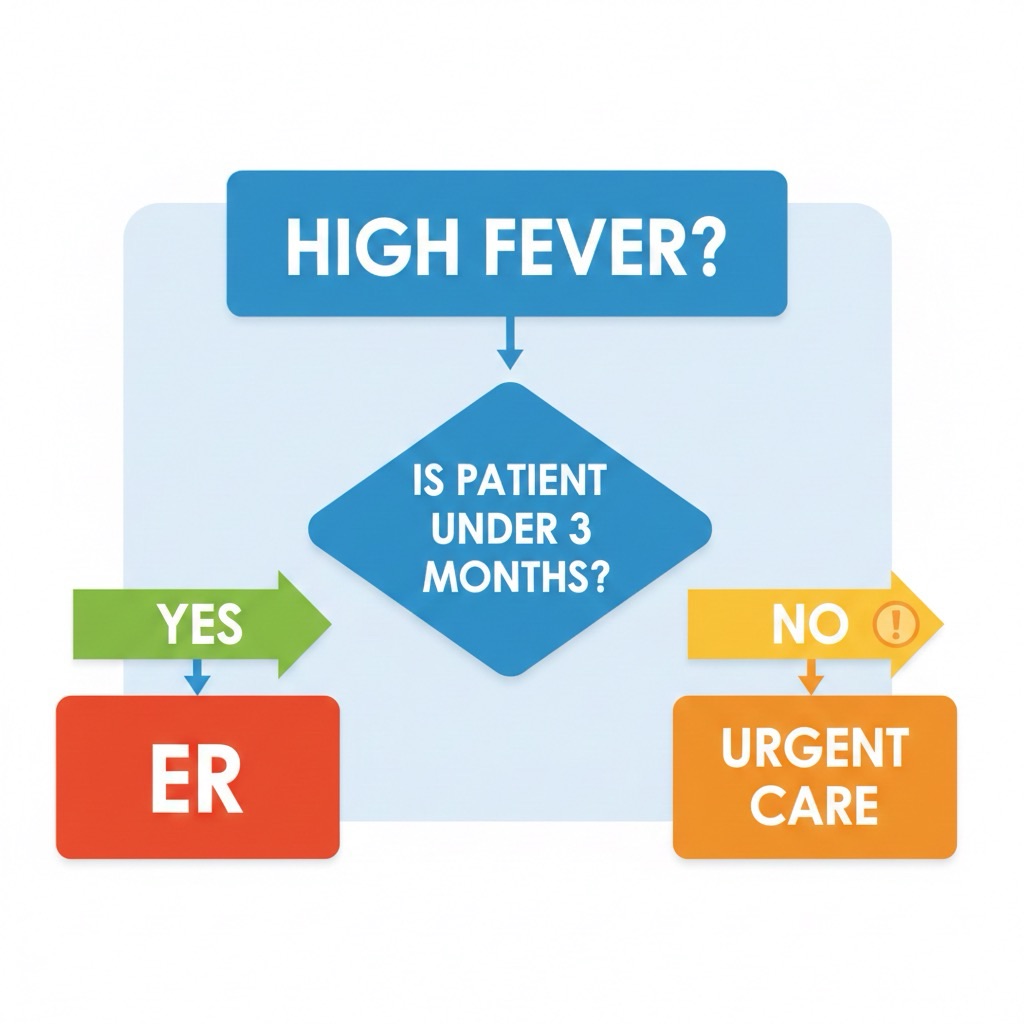
✅ In a newborn (<3 months), or with stiff neck/seizure
✅ In an older child or adult, with no severe symptoms
Cuts & Bleeding
✅ Deep, gaping, won’t stop with pressure
✅ Minor to moderate, likely needs stitches
Broken Bone
✅ Compound fracture (bone through skin), major dislocation
✅ Suspected minor fracture of finger, toe, or wrist
Abdominal Pain
✅ Sudden, severe, localized (e.g., right lower quadrant—appendicitis)
✅ Mild to moderate, general discomfort, gas, indigestion
Back Pain
✅ With loss of bowel/bladder control or leg weakness
✅ Muscle strain or chronic ache
Use this guide for reference, but always call 911 for life-threatening emergencies.
The Cost Difference: Why Your Choice Matters
This isn’t just about convenience; it’s a major financial decision.
· ER Visit Average Cost: $1,500 – $3,000+ (depending on severity and tests)
· Urgent Care Visit Average Cost: $150 – $250 (for a basic visit)
Even with insurance, your copay for the ER is typically 3-6 times higher than for urgent care. An ER visit for a condition that could be treated at urgent care is often deemed “avoidable” and may result in a higher out-of-pocket burden.
3 Practical Steps to Take Before a Health Scare
1. Save and Sort: Save this article or the decision matrix. Bookmark it on your phone. A quick visual reference in the moment can be priceless.
2. Know Your Network: Find your nearest in-network urgent care centers now. Don’t search while in pain. Know their hours (many are open evenings/weekends).
3. Use Telehealth: For true uncertainty, many insurers offer a 24/7 nurse line or telehealth service. A 10-minute video call with a clinician can often triage your situation and direct you to the right place, saving you time and money.
The Final Word: Trust Your Gut, But Guide It with Knowledge
If you are ever in genuine doubt, err on the side of caution and go to the ER. It is always better to be safe. But for the vast majority of everyday health scares—the sprained ankles, the worrisome fevers, the persistent coughs—using urgent care is the smarter, faster, and more affordable path to getting better.
By understanding this system, you become an empowered patient. You can protect your health, your time, and your wallet, while freeing up critical ER resources for those who need them most. Keep this guide handy, and breathe easier knowing you’re prepared to make the right call.
FAQs
1. What’s the #1 mistake people make when deciding where to go?
Answer: The most common mistake is going to the ER for problems that are urgent but not emergent, like a mild flu, a minor sprain, or an ear infection. This leads to long waits (as truly critical patients are seen first) and bills that can be 10x higher than urgent care. The ER is for “I might die or lose a limb.” Urgent care is for “This can’t wait until tomorrow, but I’m not in mortal danger.”
2. My injury happened after hours. Isn’t the ER my only option?
Answer: No. Most urgent care centers have extended hours, including evenings, weekends, and holidays. Always search for “urgent care near me” and check their hours online or call before assuming the ER is the only choice. Many are open until 9 PM or later.
3. I have severe abdominal pain. How do I know if it’s appendicitis (ER) or just a stomach bug (Urgent Care)?
Answer: Go to the ER immediately if the pain is:
· Sudden, severe, and sharp.
· Localized to your lower right abdomen.
· Worsens with movement or coughing.
· Accompanied by fever, vomiting, or an inability to pass gas.
If it’s a generalized, dull ache or cramping with diarrhea/nausea (a “stomach bug”), urgent care can help manage symptoms and rule out dehydration.
4. Can urgent care handle broken bones?
Answer: Yes, for minor fractures. Most urgent cares have X-ray machines and can splint or cast injuries to fingers, toes, wrists, ankles, and feet. However, go to the ER for compound fractures (bone piercing the skin), suspected hip or femur fractures, or major joint dislocations, as these often require orthopedic surgery and advanced pain management.
5. Do I need an appointment for urgent care?
Answer: No. Urgent care is walk-in by design. You can often check in online to “get in line” and reduce your wait time, but an appointment is not required. This is a key difference from your primary care doctor.
6. What if urgent care sends me to the ER? Will I be charged twice?
Answer: You will receive separate bills, but the urgent care visit is typically a fraction of the cost. The upside is that their assessment can be crucial. If they recognize a serious issue and send you, you avoided a dangerous delay. Furthermore, the ER team will have a clinical note to start from, which can streamline your care.
7. Is the quality of care lower at urgent care?
Answer: No, it’s simply different. Urgent care providers are excellent at handling a specific scope of common, non-life-threatening conditions. They are staffed by physicians, physician assistants, and nurse practitioners experienced in family medicine, emergency medicine, or pediatrics. For a dedicated emergency team and advanced equipment (like CT scanners), you need the ER.
8. My child has a 104°F fever. Where do I go?
Answer: Age is critical here.
· Under 3 months: Go to the ER immediately for any fever over 100.4°F.
· 3 months+: If the child is still alert, drinking fluids, and breathing comfortably, urgent care is appropriate. If the fever is accompanied by lethargy, a stiff neck, trouble breathing, or a seizure, go to the ER immediately.
9. What’s the real wait time difference?
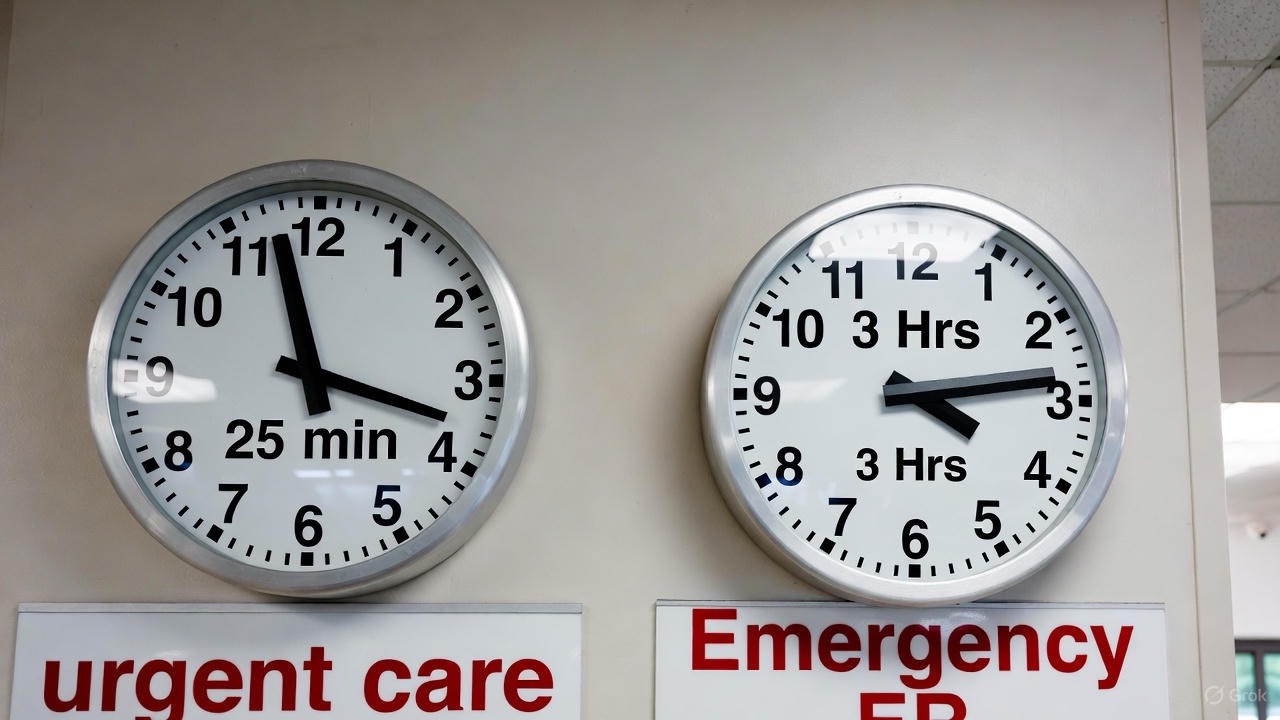
Answer: It’s significant. Urgent Care average wait: 15-45 minutes. ER average wait: 2-6 hours (triage prioritizes the sickest patients, so if you’re there for a minor issue, you will wait). Remember: in the ER, waiting is often a sign that your condition is less critical—which is a good thing.
10. I cut my hand. How do I know if it needs the ER?
Answer: Ask these questions:
· Is the bleeding bright red and spurting? (ER – could be an arterial bleed)
· Can you see bone, tendon, or fat? (ER)
· Is the cut gaping wide and won’t stay closed? (Likely ER or urgent care for stitches)
· Is it a clean, moderate cut that bleeds but stops with pressure? (Urgent Care for stitches or glue)
· Is it a minor scrape or shallow cut? (Home care)
11. Can urgent care refill my prescription if I run out?
Answer: Sometimes, but with limitations. They can often provide a short-term, emergency refill for certain non-controlled medications (like blood pressure or asthma meds) if you’ve been on them consistently. They cannot manage long-term controlled substances (like opioids for chronic pain). Always call your primary care doctor first for refills.
12. What about chest pain? Isn’t any chest pain an automatic ER visit?
Answer: When in doubt, always go to the ER for chest pain. However, if the pain is clearly reproducible (you can point to one spot and it hurts more when you press on it) and feels muscular, and you have no other symptoms (no shortness of breath, nausea, sweating, or arm/jaw pain), it could be a strain. If you have any risk factors (high blood pressure, family history, smoker) or any doubt, the ER is the only correct choice.
Bottom Line: Use this guide to make an informed choice. When your health is on the line, a few minutes of clear thinking can lead to the best care, less stress, and significant financial savings. When truly unsure, calling your primary care doctor’s after-hours line, a telehealth nurse, or 911 for guidance is always a wise step.
We use cookies on our website to give you the most relevant experience by remembering your preferences and repeat visits. By clicking “Accept”, you consent to the use of ALL the cookies.
This website uses cookies to improve your experience while you navigate through the website. Out of these, the cookies that are categorized as necessary are stored on your browser as they are essential for the working of basic functionalities of the website. We also use third-party cookies that help us analyze and understand how you use this website. These cookies will be stored in your browser only with your consent. You also have the option to opt-out of these cookies. But opting out of some of these cookies may affect your browsing experience.
Necessary cookies are absolutely essential for the website to function properly. These cookies ensure basic functionalities and security features of the website, anonymously.
Cookie
Duration
Description
cookielawinfo-checkbox-analytics
11 months
This cookie is set by GDPR Cookie Consent plugin. The cookie is used to store the user consent for the cookies in the category "Analytics".
cookielawinfo-checkbox-functional
11 months
The cookie is set by GDPR cookie consent to record the user consent for the cookies in the category "Functional".
cookielawinfo-checkbox-necessary
11 months
This cookie is set by GDPR Cookie Consent plugin. The cookies is used to store the user consent for the cookies in the category "Necessary".
cookielawinfo-checkbox-others
11 months
This cookie is set by GDPR Cookie Consent plugin. The cookie is used to store the user consent for the cookies in the category "Other.
cookielawinfo-checkbox-performance
11 months
This cookie is set by GDPR Cookie Consent plugin. The cookie is used to store the user consent for the cookies in the category "Performance".
viewed_cookie_policy
11 months
The cookie is set by the GDPR Cookie Consent plugin and is used to store whether or not user has consented to the use of cookies. It does not store any personal data.
Functional cookies help to perform certain functionalities like sharing the content of the website on social media platforms, collect feedbacks, and other third-party features.
Performance cookies are used to understand and analyze the key performance indexes of the website which helps in delivering a better user experience for the visitors.
Analytical cookies are used to understand how visitors interact with the website. These cookies help provide information on metrics the number of visitors, bounce rate, traffic source, etc.
Advertisement cookies are used to provide visitors with relevant ads and marketing campaigns. These cookies track visitors across websites and collect information to provide customized ads.